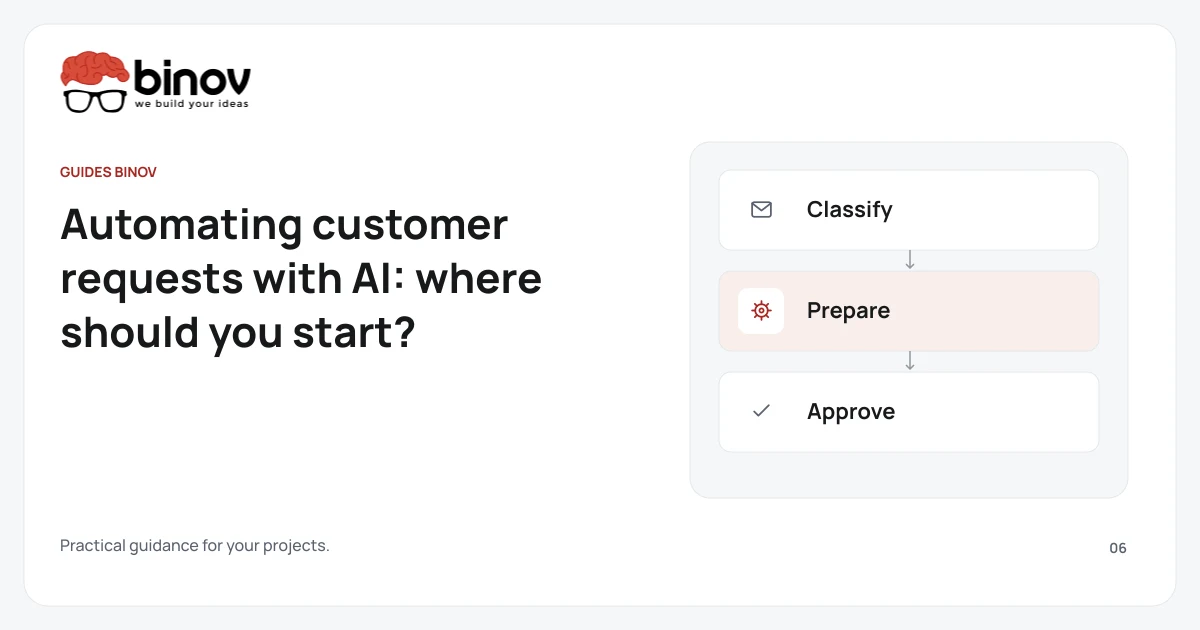
Start customer request automation with one defined category and the work before sending: classification, context gathering and drafting. Keep a clear path for exceptions and sensitive commitments. The goal is a useful, controlled response rather than simply a faster email.
Map the actual workflow
Trace a few permitted examples. Who receives the request? What information must be found? Which system holds the answer? Who approves a discount, a change or a delivery commitment?
Separate complete requests, requests needing clarification and cases for a specialist. This is more actionable than a general aim to reduce emails.
A possible first workflow
| Step | System contribution | Check |
|---|---|---|
| Reception | Identify the subject and case | Correct identity and association |
| Retrieval | Collect permitted information | Source and freshness |
| Preparation | Draft a contextual response | Accuracy and commitments |
| Approval | Show the proposed response | Authorised human decision |
| Follow-up | Update the request status | Action trace and duplicate prevention |
This is an illustrative workflow. Your first scope might automate only classification and drafting while keeping sending manual.
Design exceptions early
An ambiguous request should lead to clarification. An unknown customer, missing document or unavailable system should produce an explicit state. Avoid repeated follow-ups and messages implying that an operation succeeded when it failed.
Require a meaningful review before changing a commercial commitment or important record. The reviewer must see the content or change being approved. An approval button without context is insufficient.
Integrate without creating duplicates
Decide which system holds the authoritative case state. If the same event arrives twice or processing is retried, the workflow should recognise it. Define what happens when a colleague handles the same case manually.
Review APIs, permissions, usage limits and test environments. A named connector does not establish that every required operation is supported.
Measure the whole outcome
Compare time to an approved response, correction effort and incorrect case associations. Review the quality of handovers as well. A well-contextualised transfer to a person can be a successful outcome.
Begin with visible drafts. Expand actions only when the observed results and control rules support doing so. Document a return to manual handling.
Common questions
Must the pilot send automatically? No. Classification and drafting can be evaluated before autonomous sending is allowed.
Can several channels be combined? Yes, with a reliable case identification rule and coherent status management.
What should we prepare? Anonymised examples, request categories, connected tools and current approval rules. Use the existing workflow readiness checklist.
Compare automation approaches, prepare production readiness and explore AI automation with Binov.