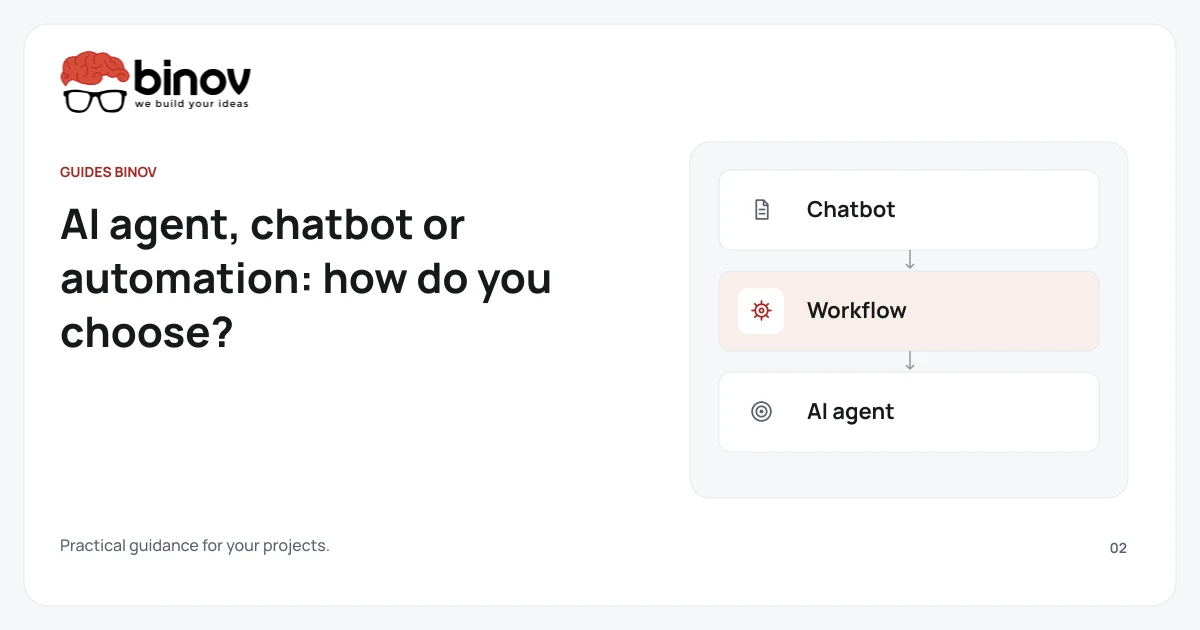
Choose a chatbot for conversational interaction, a workflow for a defined process and an AI agent when the system needs to adapt its actions to context. These approaches can work together. The right design depends on the task and its responsibilities, rather than on which label sounds newest.
Three different concepts
A chatbot primarily describes the interface through which a person interacts. It might answer questions, retrieve documents or trigger an operation. A conversational interface alone does not tell you how autonomous the system is.
A workflow organises steps such as reception, checks, processing and approval. It may include AI for classification or drafting while retaining explicit rules around those tasks.
An agent has some discretion over its next steps or tools. Anthropic describes the conceptual distinction between predefined paths and model-directed decisions. A project must specify the actual discretion granted.
Compare against the need
| Main need | Possible starting point | Key question |
|---|---|---|
| Repeated questions | Conversational assistant | Must answers reference sources? |
| Stable process steps | Workflow | Can exceptions be identified? |
| Choosing among tools | Bounded agent | Who authorises sensitive actions? |
| Helping a colleague inside an application | Embedded copilot | When does the person take over? |
These are starting points, not a ranking. An application may use all four approaches in different places.
Example: handling a document request
If the user needs an internal procedure, a document assistant may be sufficient. If a document must be generated from known fields and approved, a workflow can organise the process. If the request is incomplete and requires several systems to determine the next step, a bounded agent may help.
In every case, access rights still apply. A pleasant conversation does not replace identity checks, search boundaries or authorisation. A well-placed approval control may help more than an extra conversational step.
Questions before development
Write down the outcome and the steps that must remain fixed. Identify missing information, acceptable errors and operations requiring approval. Check whether an existing rule or a clearer interface could already solve the problem.
Test the simplest path first. Introduce additional autonomy for a demonstrated need. Compare options on the same examples: output quality, rework, error visibility and operational effort. This makes the decision about an actual service, rather than the appeal of a demonstration.
Common questions
Can a chatbot take actions? Yes, when it is connected to tools. Permissions and confirmations need to be designed regardless of the label.
Is automation without an agent outdated? No. Stable processes can benefit from straightforward, inspectable rules, with AI only where it helps.
Must we replace the application? Not necessarily. A targeted capability may fit into an existing workflow after reviewing the architecture and interfaces.
Explore enterprise agent use cases, customer request automation and Binov’s AI engineering services.