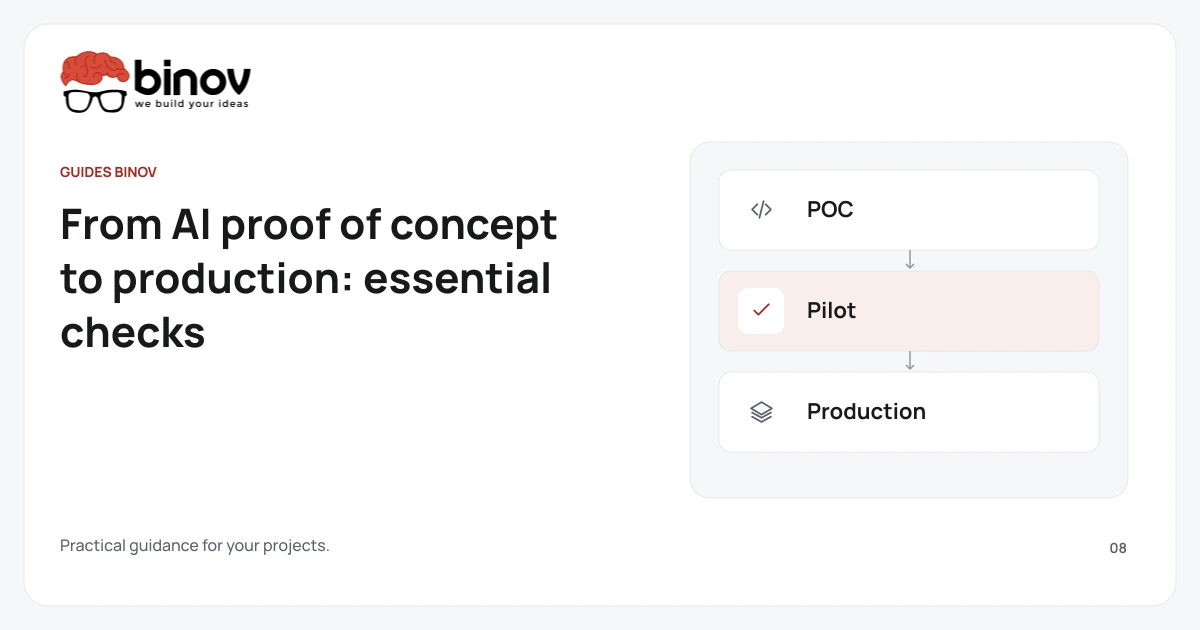
A proof of concept demonstrates that an approach can work within a selected scope. Production also requires users, permissions, failures, costs and changes to be managed. The decision should rest on observable criteria and defined operational ownership.
Identify prototype shortcuts
List assumptions that made the demonstration easier: manually prepared documents, one user, limited data, local secrets or no simulated outage. These choices can support exploration, but become explicit work before wider use.
Connect each gap to a concrete concern and a decision. “Make it production-ready” is too vague to estimate or accept. Specify the work and the evidence needed.
A readiness framework
| Area | Evidence to seek |
|---|---|
| Value | Identified users find the outcome useful |
| Quality | Ordinary, ambiguous and difficult cases are evaluated |
| Access | Profiles and permitted sources are verified |
| Failure | Errors are visible and a fallback exists |
| Operation | Ownership, alerts and procedures are defined |
| Change | Versions are traceable and can be rolled back |
Criteria should match the consequences of the system. Drafting assistance and record-changing actions have different risk profiles.
Test beyond successful examples
Build a representative set with business users. Include missing information, contradictory requests and access boundaries. Define critical errors separately from issues that can be corrected within the workflow.
Evaluate the whole task, not only writing quality. A fluent answer may still be unusable, lack required evidence or refer to the wrong case. Keep the review method stable enough to compare versions.
Make operations understandable
Define how users recognise a failure, who handles it and how context is retained. Logs should explain relevant steps without unnecessarily keeping every piece of processed information.
Set resource limits and appropriate stopping mechanisms. Interrupted and retried operations need known behaviour. Support should be able to distinguish data, model, tool and workflow problems.
Release in stages
Begin with a limited group and a disable mechanism. Expand against agreed criteria and observed usage. Prepare rollback and a manual process where practical.
After changing a model, prompt or source, rerun affected cases. Improving one example does not establish that every workflow improved. Record what was checked for each release decision.
Common questions
Does a successful POC establish full feasibility? No. It supports the scope tested; integration and operational constraints may remain.
Must everything be finished before a user pilot? A bounded pilot is possible with explicit limits, permissions and responsibilities. It should not be presented as general availability.
What should the transition deliver? A gap inventory, acceptance criteria, phased work and a defined operating model.
Continue with application integration, agent governance and Binov’s AI product studio.