
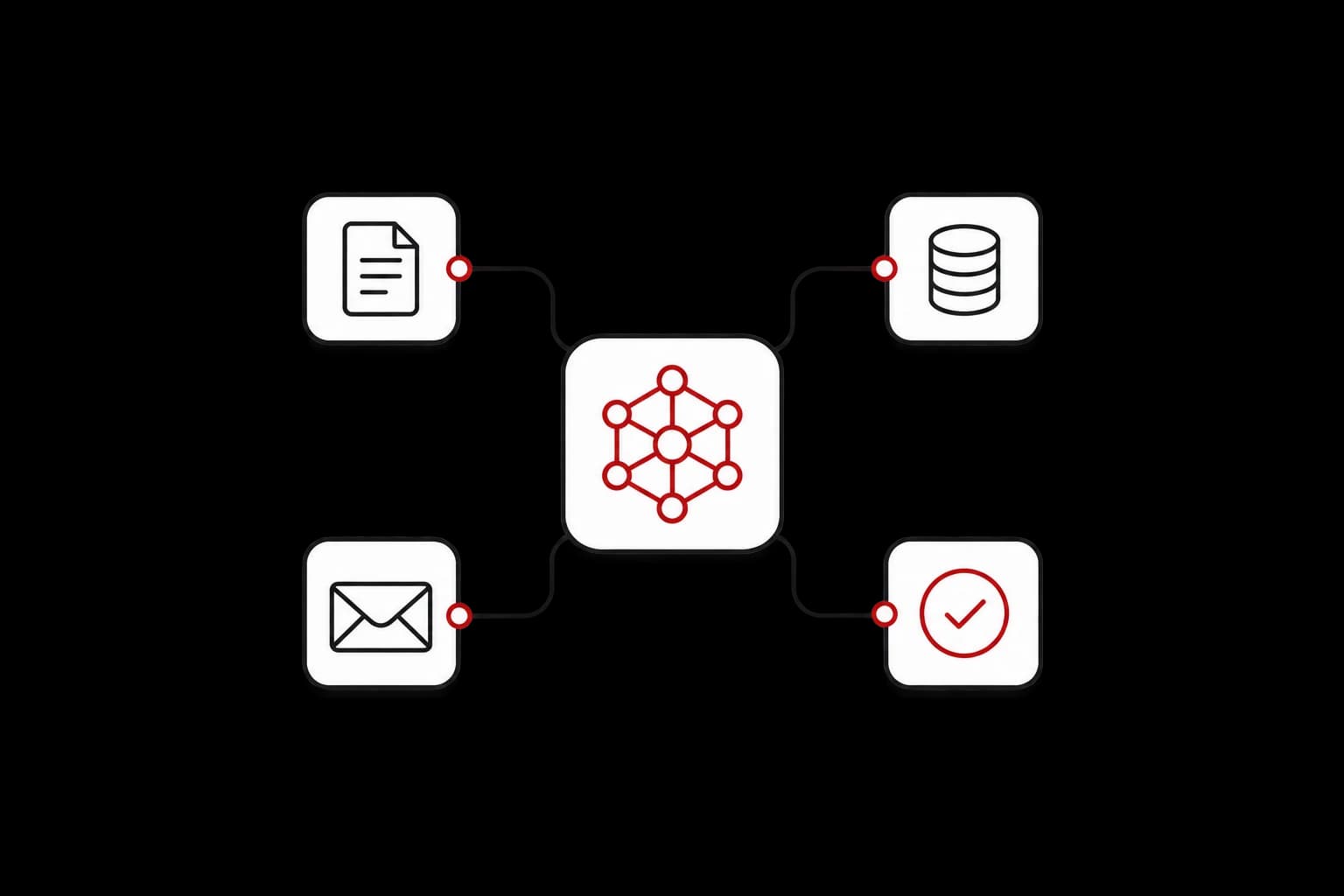
Before and after: an incoming request
Before: someone copies a request, finds the right recipient and follows its progress across several tools.
After, illustrative example: an event creates a structured request; rules validate the fields; an AI step may suggest a category; ambiguous cases are reviewed before the business tool is updated. Outcomes and errors remain visible. No numerical improvement is assumed.
A readable workflow
- Trigger: a form, application event or scheduled task.
- Processing: data validation and business rules; AI only where a task warrants it.
- Review: human checks for exceptions or actions requiring approval.
- Action: integration into the target system and verification of the result.
Which processes are candidates?
Request qualification, document routing, case preparation and tool synchronization. We first examine repetitive steps, rule stability and available interfaces. A known workflow does not necessarily require an agent: explicit rules may be sufficient.
Plan for exceptions
An API error, duplicate or missing information needs a defined outcome. We examine recovery, retry limits and alerts. Operations that cannot be undone need appropriate approval and safeguards against repetition.
Readiness checklist
- Describe the trigger, inputs and expected outcome.
- Identify the business owner and reviewers.
- List tools, APIs, permissions and data constraints.
- Supply ordinary examples and exceptions.
- Define monitoring, quality criteria and manual recovery.
Deliverables and useful questions
Scope may include a process map, rules, connectors, exception tests and an operations guide.
Where does AI fit?
At a useful step, such as classifying text or preparing a summary. Business checks and permissions remain explicit.
What happens when a tool changes?
Connectors and their tests need maintenance. Monitoring and recovery ownership are agreed during scoping.