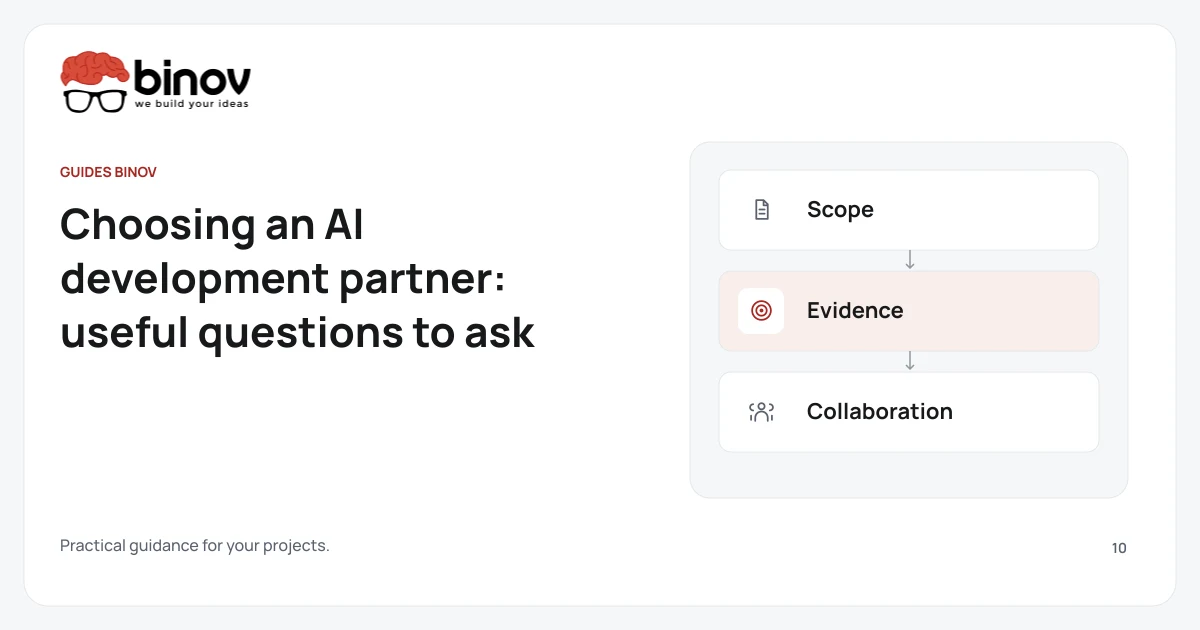
Choose an AI development partner by examining how they understand the task, evaluate results and support the product afterwards. A demonstration is useful when accompanied by a clear scope, assumptions and an explanation of operational responsibilities.
Start with your situation
You may need a defined project delivered, ongoing contribution to an existing product team or help with architecture decisions. These require different responsibilities. State what you expect the partner to own and what remains within your organisation.
Explain the systems involved, known constraints and unresolved decisions. Those details should inform the proposed collaboration.
An interview framework
| Topic | Question to ask |
|---|---|
| Discovery | How do you turn needs into acceptance criteria? |
| Architecture | Which choices are reversible and which dependencies arise? |
| Integration | How are permissions and existing interfaces verified? |
| Quality | Which examples and failures will be evaluated? |
| Collaboration | Who decides, approves and manages changes? |
| Operations | Who handles output or tool problems? |
| Handover | What code, documentation and knowledge do we receive? |
Seek answers specific to your situation. A list of technologies does not answer these questions by itself.
Examine a useful demonstration
Ask which data was used, which steps were simulated and what happens when information is missing. An illustrative demonstration can be valuable when its scope is explicit.
Review correction and approval paths as well as successful output. Notice whether the partner can distinguish missing data, integration constraints and design problems. That distinction helps estimate the next phase.
Compare equivalent scope
Identify deliverables, assumptions and exclusions. Separate implementation from operation and maintenance. Clarify how requirement changes will be evaluated and agreed.
Discuss access to code, environments and documentation, external dependencies and how another team could take over. Record the practical arrangements in the relevant proposal and contractual discussions.
Use a first phase to support a decision
A first phase can provide requirements, an integration check and a demonstrable workflow using representative examples. Agree which decision it should enable. An exploratory phase should not be presented as a complete product.
Binov’s proposed starting point connects business objectives to product and architecture choices. The collaboration can then focus on project delivery, contribution to your team or technical leadership.
You can explore Beez360, a Binov product, as a concrete example. Its existence does not establish that its features or architecture fit your future project.
Common questions
Should we choose a specialist in one tool? Familiarity with your tools can help, alongside understanding, integration and maintenance capability.
Is the lowest price comparable? Only when scope, assumptions and responsibilities are comparable. Use a shared breakdown.
Can the engagement change later? It can be planned around product progress and the needs and responsibilities of your team.
Read about AI agent budgets, production readiness and Binov’s engagement options.