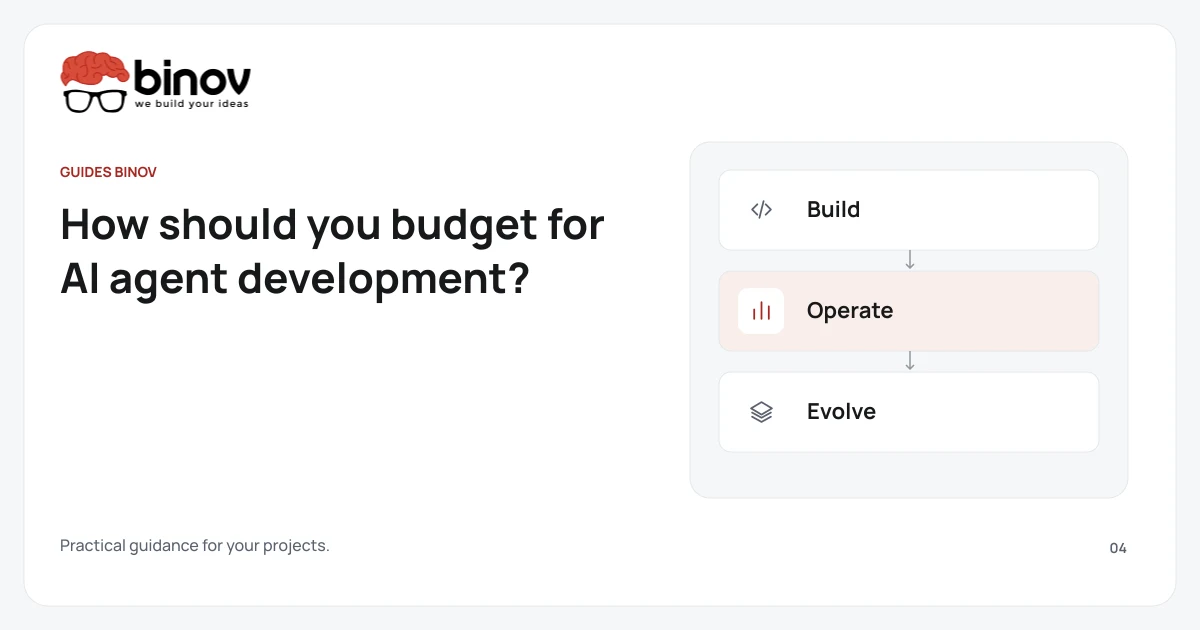
An AI agent budget depends on scope, integrations, data quality and the level of control required. Compare proposals by separating implementation, operation and ongoing change. Model usage is only one component of the total cost.
Separate the main cost areas
| Area | What it includes | Main uncertainty |
|---|---|---|
| Discovery | Use cases, boundaries, examples and acceptance | Unresolved decisions |
| Integrations | Systems, identities and data connections | Interfaces and permissions |
| Development | Workflow, orchestration and interface | Actions and exception variety |
| Evaluation | Test cases, reviews and corrections | Error consequences and case diversity |
| Operation | Hosting, models, storage and monitoring | Volume and availability |
| Maintenance | Support and adaptation | Changes in systems and business needs |
A useful estimate states its assumptions. A standalone price without a defined scope does not support a fair comparison.
Build three usage scenarios
Describe a starting scenario, expected usage and higher demand. For each, consider task volumes, documents consulted, acceptable response times and the proportion of cases requiring human review. Use documented ranges when precise data is unavailable.
Look at cost per approved outcome. Include model calls, retrieval, paid tools, hosting and review effort where relevant. A lower price per call can be offset by repeated attempts and corrections.
A calculation structure to adapt
For a response-drafting assistant, distinguish requests processed, responses approved and manual rework. Monthly operation can be represented as fixed costs plus variable processing costs plus review and support effort.
This is not a Binov quote. It identifies what a pilot needs to measure. When assessing return, consider quality and capacity actually released. Theoretical time savings do not automatically become a financial saving.
Compare proposals on equal terms
Check connectors, access management, test environments, approvals, documentation, knowledge transfer and incident handling. Ask what happens when a connected tool changes or a new request type appears.
Clarify reusable components, supplier dependencies and the recovery of code and data. A demonstration may intentionally cover a narrow scope, but its limits and the work needed for production should be explicit.
Reduce uncertainty through a first phase
A first phase can test a difficult integration, the usefulness of a document source or the review criteria. Its output should support a decision to continue, narrow the scope, change the approach or stop. Subsequent phases should follow that evidence.
Common questions
Is there a standard price? This guide does not provide a generic rate. A relevant proposal requires an understanding of the task, systems and constraints.
Does a prototype cover production costs? Not necessarily. Monitoring, permissions, failure handling and maintenance may require additional work.
How can we control scope? Agree assumptions, acceptance criteria and a process for deciding on changes before implementation expands.
Prepare agent requirements, review how to choose a partner and discuss your project with Binov.