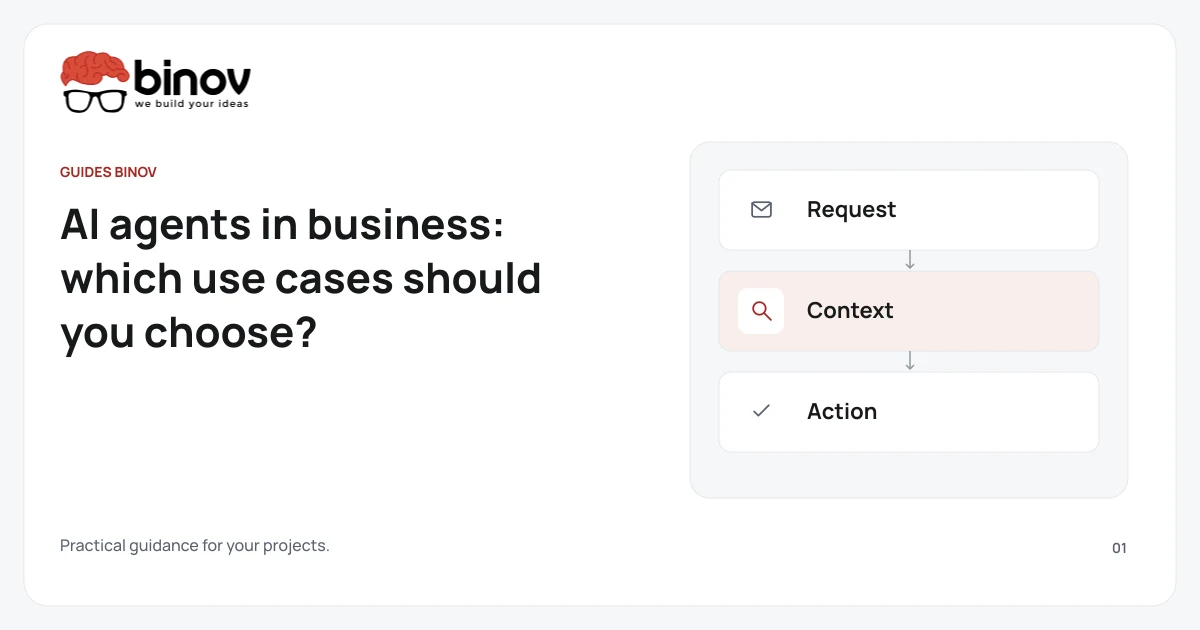
A useful first AI agent project addresses a specific task, has access to relevant information and produces an outcome that people can check. Start with a frequent, reversible operation and an identified business owner. The number of agents matters less than the usefulness of the workflow.
Start with an observable problem
“Bring AI into the business” does not define a project. Describe an actual situation: a request arrives by email, a colleague checks several systems and prepares a reply. Identify repeated work, missing information and decisions that require judgement.
An agent may choose tools and adapt its next actions to the context, while a predefined workflow follows paths set in code. Anthropic’s distinction is useful when discussing autonomy. It does not imply that every automation needs an agent.
Four situations worth examining
| Situation | Possible contribution | Human control |
|---|---|---|
| Customer requests | Collect context and draft a response | Approve commitments to customers |
| Document research | Find and explain relevant passages | Check sources and access rights |
| Incomplete cases | Identify missing items and draft a follow-up | Verify recipient and message before sending |
| Decision preparation | Compare information and flag inconsistencies | Keep the decision with its accountable owner |
These are illustrative situations, not claims about customer deployments. Value depends on your systems, data quality, workload and existing practices.
Select a manageable scope
Ask five questions. Does the task recur often enough to justify a project? Is the information accessible? Can someone recognise a correct result? Can a mistake be reversed? Who will handle exceptions?
A modest, measurable scope is easier to assess than a broad promise. Drafting a reply from a defined case file is more specific than “manage all customer relationships”. Gather permitted examples for a pilot, including an ordinary request, an ambiguous one, a missing document and conflicting information. Asking for clarification or handing the case to a person should be valid outcomes.
Measure a useful result
Look at the total time to an approved outcome, rather than generation speed alone. Track corrections, significant errors and abandoned tasks. A fast answer followed by lengthy rework may deliver little value.
Identify who owns permissions, business decisions and incident handling. List actions that are permitted, actions requiring approval and actions outside the scope. Keep a manual fallback and make it visible to users. These operational choices should be made before expanding the pilot.
Common questions
Do we need multiple agents? No. One bounded workflow can establish value. Additional agents introduce coordination and failure points that need a clear purpose.
Can we keep our existing tools? Usually the first step is to examine their interfaces and permission models. Integration should be confirmed rather than assumed.
What should we prepare? A description of the task, a few anonymised examples, the systems involved and your current approval process.
Read the agent, chatbot and automation comparison and the AI agent requirements guide. Explore AI agent development with Binov.