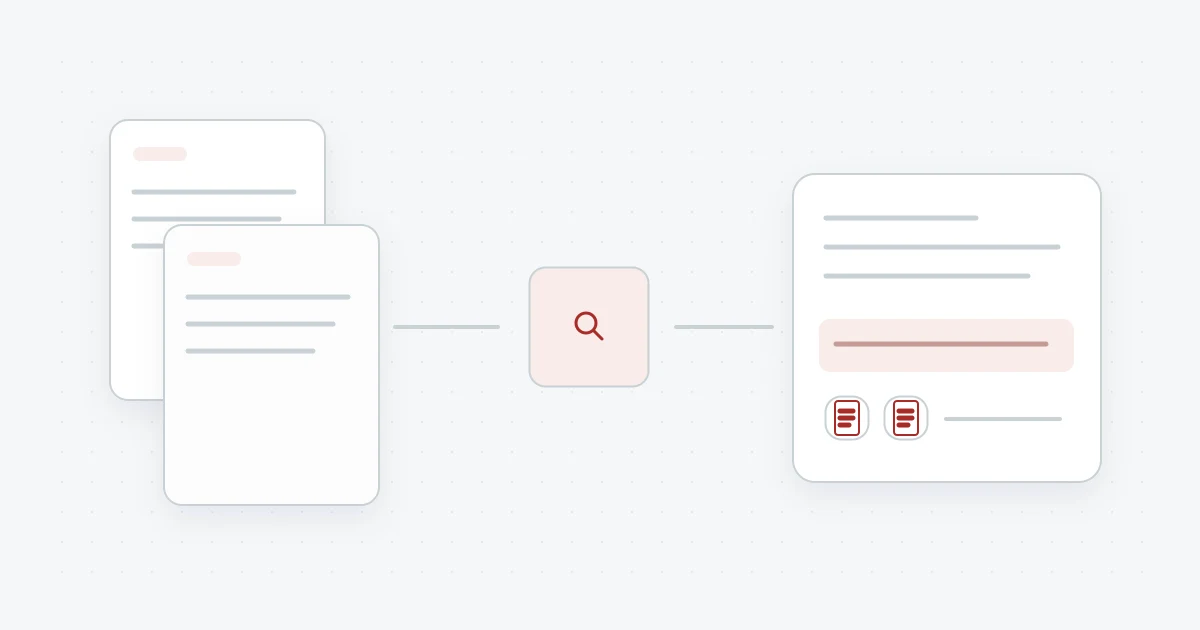
A sourced answer you can check
Illustrative example — “Which procedure applies to a refund request?” The system retrieves passages available to the user and proposes an answer naming the document and section used. Missing, contradictory or outdated sources should be flagged; the interface lets users return to the original document. This example is neither a client application nor a guaranteed result.
Connect knowledge to search
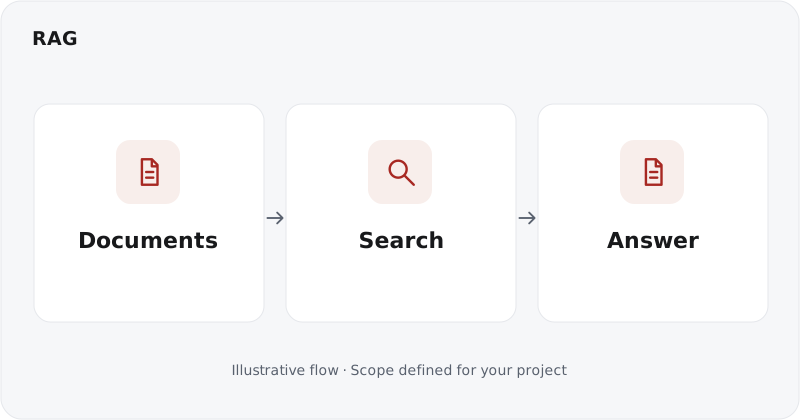
- Sources: documents, wikis, tickets or business repositories with identified owners and update rules.
- Preparation: extraction, chunking, metadata and indexing, accounting for versions and deletions.
- Retrieval: access filters, semantic or hybrid search and ranking of useful passages.
- Response: contextual answers, accessible citations and the option to report insufficient evidence.
Practical knowledge use cases
Assist support teams with approved procedures, find a decision in project records or explore an internal reference library. RAG supplies knowledge; acting in another tool requires additional integration and separate permissions.
Access, evaluation and limits
Access rights apply during retrieval, not only in the wording of an answer. We define reference cases to assess passage relevance, faithfulness to sources, responses to missing information and unauthorized access attempts. Instructions inside a document must not become execution instructions.
Quality depends on the corpus, permissions, model and index updates. A citation alone does not guarantee accuracy. We plan user feedback and conditions for reevaluation.
Deliverables agreed during scoping
Source and access mapping, ingestion pipeline, search experience, evaluation set, integrations and operating instructions. Scope is agreed with your team before the pilot.
Useful questions
Does RAG replace document management?
No. It relies on documents and their owners. Their quality and lifecycle remain essential.
Can sensitive information be connected?
Sources, processing, hosting and access must be reviewed with the relevant owners before integration.